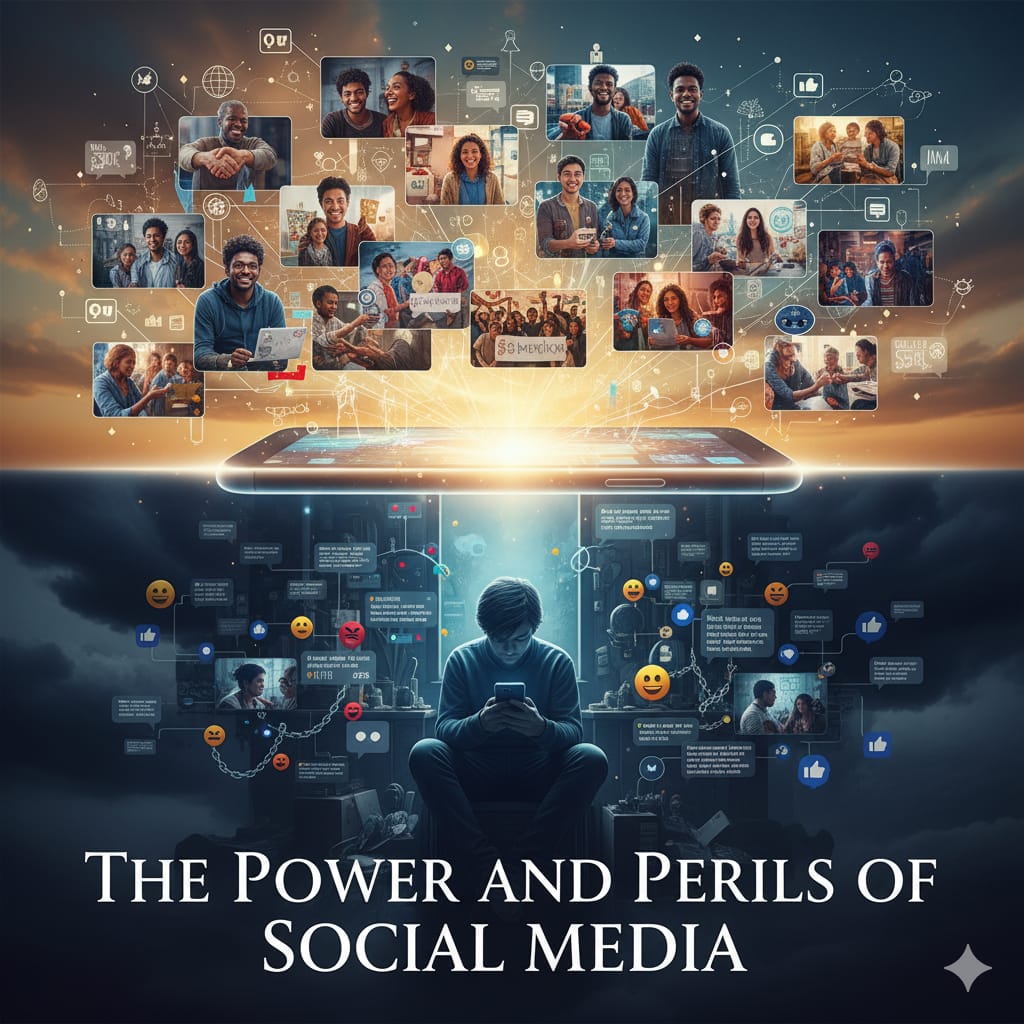
Social media : An overview
The relevance and significance of social media in the educational sector has been studied under the title ‘Social Media: An Innovative Teaching Tool.’ In today’s world, the concept of ‘glocal’ (global + local) provides a platform for people across the world to exchange cultures, customs, knowledge, and perspectives. The study suggests that social media should be widely integrated into education, and that our educational system must reform accordingly. It is most commonly used for creating presentations, sharing assignment updates, conducting research, and enhancing connectivity.
With the world transitioning from global to glocal, boundaries,economic, social, and political are narrowing, and a shared platform for progress is emerging. Media convergence has accelerated internet use, leading to the rise of social media. It serves as a forum for community discussions, while also being used by businesses to promote themselves, professionals to network and hire, and parents and teachers to facilitate social learning.
Social learning tools are at the heart of educational use of social media. Put simply, a social networking site is “a tool that enables collaboration between parents, teachers, and students online.” Students use social media creatively to write blogs, build professional connections, make event or class announcements, and share information with peers, parents, and teachers.
Social learning theory states that students learn best from each other. Studies have shown that group study improves grades, engagement, and motivation. For decades, teachers have promoted group learning, and social media now strengthens this practice. It enhances communication, helps shy learners find their voice online, and even improves writing skills.
Social media marketing
As of now, nearly 4.8 billion people worldwide use social media platforms. This makes social media marketing a powerful tool for businesses to reach potential customers globally. Social media marketing refers to promoting products, services, or brands through platforms such as Facebook, YouTube, Instagram, Twitter, and others.
Why should companies focus on social media marketing?
• Reach customers worldwide
• Increase brand awareness
• No minimum cost to create accounts
• Easy content sharing boosts engagement
• Hashtags expand audience reach
• Targeted ad boosting (e.g., posts for ages 21–25)
Types of social media marketing include content marketing, advertising/sponsorships, paid promotions, and influencer marketing.
The top five platforms—Facebook, YouTube, Instagram, Twitter, and WhatsApp—provide businesses with high audience engagement and profit potential.
Social media and the dopamine effect
Students are the backbone of a nation’s future, contributing to progress in science, technology, politics, art, and more. Therefore, it is essential to create a focused environment for them. However, social media has become a major obstacle to student achievement. Unfortunately, children are the most vulnerable.
Did you know most social media applications are designed to keep users engaged? Content is sorted based on user preferences, and with every click, platforms gather more data to deliver targeted advertisements—often unnoticed by the user.
Social media usage releases dopamine levels comparable to drug use. Just as drugs are restricted for children, shouldn’t there be stronger safeguards for social media? Currently, there are no clear laws or age boundaries restricting minors from using these platforms.
Every ping or notification offers a sense of connection and acceptance,yet this is often far from reality. The brain develops a habit of instant gratification, which undermines patience, skill-building, and long-term growth. Learning and success, by contrast, require time, persistence, and resilience through failures.
It is crucial for parents and teachers to create healthier environments at home and school. This can be difficult when adults themselves are addicted to social media. Still, we must ensure that children have the space to focus, without constant interruptions from instant gratification.
Success takes time ,often years or even decades. Let each student experience their journey fully, without shortcuts.